
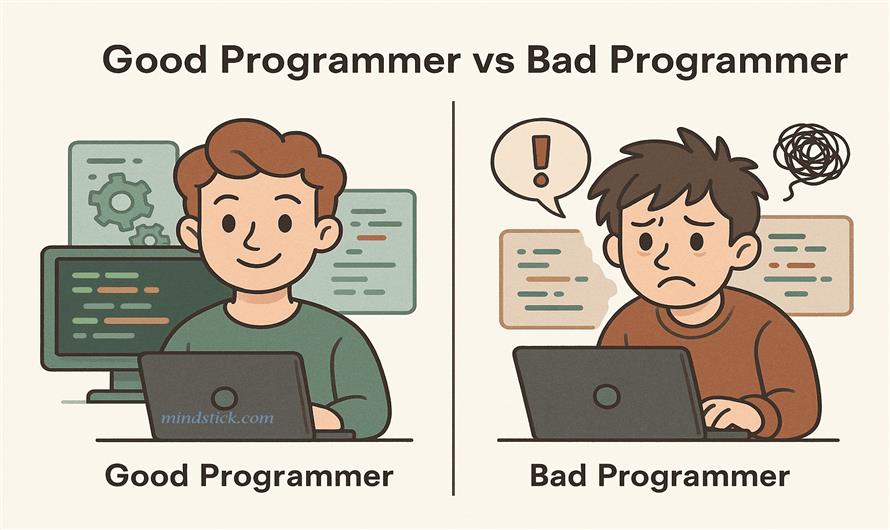
Software development; good versus bad programmers is a lot more than just having the technical skills. Yet the ways they thought, the habits they have and the approach they take while writing functional code is altogether different. The good programmer will invest time in delivering clean, maintainable code that is easy to collaborate on and easy to learn, while the bad programmer will produce buggy hacks that are practically impossible to maintain, something they don’t believe in anyway. Such differences make a difference in both individual performance and team productivity and software quality. Knowing what the difference is can help aspiring developers improve towards becoming great engineers and organisations build great engineering teams. In this article we’re going to explore the main differences between a good and a bad programmer.
Code Quality and Maintainability
Good programmers produce code that is clean, modular, well documented, easy to read, easy to maintain. They even follow best practices such as SOLID principles, DRY (Don’t Repeat Yourself) and adhere to naming conventions. Their code is also scalable such that it reduces the technical debt for future developers. By comparison, bad programmers leave all of the messy, hard to read code with bad, redundant structure and no documentation. What they value is speed; not sustainability which means bugs and inefficiencies are given priority and will slow development in the long run.
Effective use of version control allows good developers to commit logical changes with descriptive messages. Good programmers use version control and therefore good ones shouldn’t need to have a dependencies section. Bad programmers either neglect version control or use it haphazardly, making collaboration difficult. Finally, code reviews are different: good programmers will take constructive criticism on the chin to make their work better, while bad programmers will take feedback personally or just ignore it. In the end what matters is the quality of code: whether you have a thriving project or maintaining a nightmare.
Problem-Solving and Debugging
Good programmers think through their problems, dividing them into bite sized pieces and testing the solutions step by step. To solve these bugs, they use debugging tools, logs and even unit tests where applicable. Unlike left to guesswork, they took time to work out root causes because temporary patches are not what they want.
But bad programmers quickly apply hacky solutions to cut corners which they don't fully grasp the problem behind. They still might miss edge cases and that will lead to unexpected failures in production. They waste time making random changes instead of diagnosing the issue properly when bugs arise.
They are also good programmers in that they anticipate the ways in which something can fail and write something that more or less will defend themselves; where bad ones assume everything will work just fine. Their applications are, often, unstable for lack of thorough testing. Those who build robust systems and those who build error prone software differ in a strong problem solving mindset.
Collaboration and Communication
Good programmers know collaboration is not an accessory add on when you have an entire team performing the software development. They articulate themselves clearly, know how to document and make active contributions to the discussion. Writing meaningful commit messages, keeping a project doc and giving helpful comments during the code review — they respect others' time.
Rather, bad programmers work in isolation, rarely documenting their thought process. As a result of poor communication they make mistakes in communicating which results in misunderstandings, duplicated efforts and delayed projects. In addition, they may also resist feedback, perceive it as criticism rather than as a way to better get things done.
Good developers can evolve to work in a team's workflow into anything from Agile to Scrum to Kanban while bad programmers refuse any process and you have projects that fail to meet deadlines or won't be released. Transparent and mutually growing team with good programmers flourishes, bad programmers generate friction, slow the progress and decrease morale.
Learning and Adaptability
Technology advances rapidly and good programmers keep up by maintaining their knowledge. They try out new frameworks, languages or rather, best practices and run experiments in their work with them. To learn, they read documentation, study online courses and work on open source projects.
Bad programmers don't evolve, they calcify; they live on old knowledge. They choose to keep working (for lack of a better word) in comfort, offering what they know best — even if it’s obsolete — for fear of learning a new technology. Faced with a new challenge, they don’t upskill; they struggle.
Good developers will take constructive criticism and learn from their mistakes while those bad ones will repeat the same mistakes without looking back. Tech folks need a growth mindset—adopt or get crumpled.
Work Ethic and Professionalism
Good programmers will claim responsibility for what they submit and do their best to make it the very best. They miss deadlines, communicate only upon the final fixed moment to act on urgency or worse yet, never communicate at all about blockers and come off as unprofessional. It’s the people who write tests, optimize performance and ensure security is considered.
This bad programmer begins cutting corners. Where initially the code is created with good intent (if less than optimal standards), the programmer begins to slip in delivering incomplete code or buggy code. Failures are blamed on others, deadlines are missed with no warning and no consideration given to security or scalability, non functional requirements nor anything else.
Professionalism is at the workplace too—good programmers are nice to people even if they don’t know them, bad ones sometimes are arrogant or negative. A strong work ethic builds trust, makes you reliable, while unprofessional behavior breaks team dynamics and kills project success.
Conclusion
Good and bad programmers differ in the way they code, solve problems, work with others, learn and are professionals. Bad programmers get technical debt, impede progress, while good programmers are building sustainable, efficient systems and good team environments. To be a great developer and be able to excel in day to day activities an aspiring developer should clean code, continuous improvement and communication. Likewise, organizations must build high performing engineering teams that recognize these traits. Thus everything that ultimately makes a programmer truly excellent is to practice best practices, be adaptable and grow.
Read also: How Can We Pick the Best AI Image Generators?


Leave Comment